Friday, February 13, 2015
Rights for Women
Women have not always had the rights that women today have. The 1800s brought about a hard time for women and the need for reform in their rights as upstanding citizens. The article "Notes on The Cult of Domesticity and True Womanhood" by Catherine Lavender gives four characteristics of "an ideal woman" of the 1800s. The first is piety or purifying society through religion. The second is purity, especially sexual. A woman's greatest treasure was thought to be her virginity. She was able to use sex as a power, controlling the sexual needs and desires of men or as a means to get her way. The third characteristic is submissiveness. A lady had to have a "pliability of temper, and humility of mind." Her clothing also needed to be submissive. Women usually wore corsets to create an hourglass figure of their body. The weight of her overdresses limited her physical mobility, aiding the argument that women were the weaker sex. It was also said that "a really sensible woman feels her dependence," usually on the people around her. The last characteristic of an ideal woman is her domesticity. Women were to stay in the private sphere, or the home where nobody could really see them. The public sphere was the world outside of the home, meant mainly for men who worked. The Cult of Domesticity explains the idea that the lives of middle class women are confined to the home. The proper role of these women was to take care of the house and children and to provide a comfort and companionship to men, while staying out of the public eye. Societal rules for women were very strict, but a fight coming right from the source was about to emerge.
The Seneca Falls Convention was a gathering of both men and women who wanted reform of the views of women. They, as a group, created the Declaration of Rights and Sentiments. It is similar to the Declaration of Independence in the way that it starts and the message it sends. Both documents are declaring freedom for a higher rule they cannot escape. In this case, women are trying to escape rules on how society and the people around them think they need to behave. A very controversial resolution that was part of the Declaration of Rights and Sentiments was suffrage for women. The right to vote was heavily debated because it was thought that a woman would vote the same was as their husband. This is not a fair assumption because only some women are married, others are single, and some others are even widowed. Women were also thought to be "intellectually inferior" and people thought they would not be able to make the right decision while voting. Though the right to vote was one of the many resolutions that were heard at the convention, many groups of women's ideas were not addressed.
Groups of people who did not attend the convention includes, Cherokee women, Slaves, and mill workers. In class, we broke up into groups that represented all of the people who did not actually attend this convention and though of what their resolutions might have been. For the Cherokee women, they wanted to preserve their language, beliefs, and their land. Slaves wanted an end to slavery. And for mill workers, they wanted equal pay for equal work. Because only upper-class white females and males attended the Seneca Falls Convention, none of these problems were ever touched. There were a few similarities between the resolutions we thought of in class and the resolutions that appear in the Declaration of Rights and Sentiments. For example, the class thought women should have a right to speak in public, but the Declaration only goes so far as to say they should be encouraged to speak at religious assemblies. Both the class and the Declaration thought women should have a place in the public sphere and should not be confined to their homes. We also had the idea that women should have suffrage. A difference between what the class said and what the Declaration states, though, is the idea that men and women should have the same social standards as each other.
To me, the most important resolution was the idea that women should have a place in the public sphere. Though this does not give a woman direct rights, it lets her be open to the real world. It gives her a chance to be heard by other people. Nobody should be confined to their home, no matter their sex, race, or religion. Women deserved the right to live like men even if society could not accept that in these times. Our society has accomplished many of the resolutions stated in the Declaration. I feel that we still need to work on equal pay for equal work, but in general, women have the same God-given basic rights that men have.

Thursday, December 4, 2014
Food Rations in Kenya Cause Concern to US
In the article "US Concerned by Ration Cuts to Refugees in Kenya" by Teresa Welsh, it shows the concern the U.S. has because of rations cuts the World Food Program has had to make to refugees in Kenya. The food given to nearly 500,000 refugees in camps in northern Keny will be cut in half, decreasing the calorie count from 2,100 to 1,050 a day. The U.S., just in 2014, provided $111 million to refugees as a part of its $5 billion spent in humanitarian organizations around the world. The World Food Program struggled to raise $38 million to fund its operations for the next six months and is now facing the consequences. Funding shortages are the main reason for ration cuts, while world crisis also put a strain on the system with more and more people seeking refuge and help. This money shortfall is also forcing refugees to be prioritized, making it only the more difficult for those not on the priority list to go along with their normal lives.
If the U.S. was to follow the lasting principles of the Monroe Doctrine, the U.S. would not be taking the actions it is today. By the policy of non-intervention, the U.S. said that if a situation does not effect us directly, we will not get involved with it. Helping those in Kenya, although very nice, goes against the Monroe Doctrine directly. Refuges in Kenya do not affect those who live in the US directly. It is not clear, besides showing compassion, why the U.S. is intervening with these refugees when really we are spending tons of money on a situation that is not in our country or improving our country when this money could be spent on solving our own issues. This situation, in part also contradicts the idea of non-colonization, and not dominating a country. By the U.S. putting themselves into a situation in another county when they are becoming depended upon, it gives the idea of domination, something the Monroe Doctrine wanting to avoid.
Welsh, Teresa. "US Concerned by Ration Cuts to Refugees in Kenya." US News. U.S.News & World Report, 26 Nov. 2014. Web. 5 Dec. 2014. <http://www.usnews.com/news/articles/2014/11/26/us-concerned-by-ration-cuts-to-refugees-in-kenya>.
Monday, December 1, 2014
The Factor of Race
In class, we learned about the many countries of Latin America and their fight for independence from their "mother countries." In Brazil, they experienced the most peaceful transition from a country ruled by Portugal to and independent country. It started when King John VI arrived in Brazil as Portugal's prince regent in 1808. By 1815, John VI had elevated the status of Brazil to a kingdom. An uprising in Portugal from Portugal's army in 1820 forced John VI to return to Portugal in 1821 and leave his son, Pedro, in charge of the kingdom. In 1822, Pedro declared independence for Brazil. Finally in 1824, Pedro wrote and enacted a constitution for Brazil and in 1825, Portugal recognized Brazil as an independent country. In this revolution, race was not a factor. This allowed for less bloodshed during the revolution, but it also meant that slavery was not identified or dealt with. Not focussing on race meant there was a longer lasting hierarchy in the country and more social class divisions.
Though race did not play a role in the revolutions of Brazil, it did play a major one in the trials that recently occurred in Ferguson, Missouri between a black teenager who was shot and killed by a white police officer. In the article "Darren Wilson Resigns from Police Department," the author William Welch explains how these trials have forced Darren Wilson, the police officer to resign from his job. Based on the jury's decision, they did not indict Wilson, who had killed Michael Brown a few months prior. Riots broke out in Ferguson, a mainly black community, because they felt this white officer had wrongly treated this black teenager who was meaning no harm. It was said that if Wilson kept his job at the Police Station, the lives of the officers and community would be at risk. Wilson would not allow this to happen and willingly resigned from being a police officer.
Welch, William. "Darren Wilson Resigns from Ferguson Police Department." USA Today. Gannett, 1 Dec. 2014. Web. 1 Dec. 2014. <http://www.usatoday.com/story/news/nation/2014/11/29/woman-loses-eye-ferguson/19660629/>.
Though race did not play a role in the revolutions of Brazil, it did play a major one in the trials that recently occurred in Ferguson, Missouri between a black teenager who was shot and killed by a white police officer. In the article "Darren Wilson Resigns from Police Department," the author William Welch explains how these trials have forced Darren Wilson, the police officer to resign from his job. Based on the jury's decision, they did not indict Wilson, who had killed Michael Brown a few months prior. Riots broke out in Ferguson, a mainly black community, because they felt this white officer had wrongly treated this black teenager who was meaning no harm. It was said that if Wilson kept his job at the Police Station, the lives of the officers and community would be at risk. Wilson would not allow this to happen and willingly resigned from being a police officer.
Welch, William. "Darren Wilson Resigns from Ferguson Police Department." USA Today. Gannett, 1 Dec. 2014. Web. 1 Dec. 2014. <http://www.usatoday.com/story/news/nation/2014/11/29/woman-loses-eye-ferguson/19660629/>.
Friday, October 31, 2014
Congress of Vienna Talks Power
When a king or president is having their power threatened, they will do everything they think is right and justifiable to get their power back. For example, in class, we took real decisions that Prince Charles von Metternich was faced with and had to decide what his actual actions were. We had to decide what Metternich would do about the redrawing of the map of Europe, establishing a new leader of Europe with the absence of Napoleon, and how to discourage new revolutions from occurring.
In preventing new revolutions, the Principle of Intervention was introduced. This principle was brought about because of the warfare Metternich had seen spread across countries that caused many deaths. It was the idea that if a country in Europe was experiencing revolutions, other European countries had the right to enter into the revolutionary country and break up the revolutions. The country intervening with the revolutionaries had the order to restore monarchs to their power. With this ideal in place, many future revolutions were stopped and monarchs kept their power. If a revolution did occur, it was considered treason and against the will of God, therefore making it highly punishable. Governmental forces were able to crush revolutionaries and protect the monarch's power.
I do not completely agree with the Principle of Intervention and think there is a better way to go about the situation of revolutionaries. The Principle of Intervention would only cause more death of the people of a country, not create lasting peace. A better way to go about this may have been for monarchs to show more kindness towards their people in order to stop ideas of revolutions. The leaders in Europe should have thought of giving the people of Europe more rights, like religious freedom and freedom of speech, so as to make their people happy and give them no reasons to revolt.
Thursday, October 16, 2014
Star-bursts and Capitalism
During our class experiment, we were each given 3 stars bursts by Ms. Bailey, but three people were given 10. Once explained, we were able to play each other in Rock Paper Scissors Shoot. If we won the game against the person we played, we took one of their star-burst from them. This was representational of an open market where everybody was able to compete for star-bursts, money. If you lost all of your star-bursts, you were considered out. There was stealing that went on among classmates to gain more star-bursts as well.
The first part of this experiment showed us capitalism at work. Once our alloted time was over, Ms. Bailey collected everybody's star-bursts and redistributed them to everybody so no person one had more than any other person. This showed us socialism where everybody is considered equal. Now with everybody being equal, the game started again. With Ms. Bailey having no control over any aspect of the game, this part of the experiment showed us communism.
I thought that playing the game was both fun and frustrating. I thought it was funny to see how different people thought and reacted during the game. It showed what people were adventurous and who just wanted to be content with what they had. I thought Jacquelyn's reaction to people trying to steal her candy was funny as she brought out a ruler and warned Julia and myself that it has a sharp edge. My frustration came from losing a star-burst to such a simple game like Rock Paper Scissor Shoot that is based on luck and cannot show skills or talents you have.
From our class discussion the next day, I heard a lot of options I can agree with. I truly agree with Catherine when she said that playing the game using Rock Paper Scissors Shoot was unfair because it showed a person's luck and not their skill. It also did not take into effect the position that person holds in society. I also agree with Austin when he said that the invisible hand, proposed by Smith, is only good to run small businesses but is not suitable for the entire economy. An example that shows this is the supermarket Atlantic and the invasion of bigger supermarkets like Market Basket and Stop and Shop. The invisible hand was working well without these big supermarkets because Atlantic was able to compete with other small markets and stores that sold similar things to them and they were in competition to keep prices low. With Market Basket and Stop and Shop now present, Atlantic was unable to keep up with the demand that was expected of them, based on what bigger supermarkets were doing. The invisible hand is not the best idea because though the economy will eventually balance out, it will take a very long time. And with this in mind, this is the reason we see the government having to step in and take charge in the economy so they are able to balance it themselves and control it.
Marx did not believe in the ideas of capitalism and was known as the father of socialism and communism. He believed that with the freedom to complete in capitalism, there will be classes that came out with lots of money and classes with little or no money. The poor classes would experience a struggle and complain about it. In addition workers will revolt against the system and there will be people who liked the free market and others who hated it, based on their success. The government will then be forced to collect all the assets of the people and bring economic equality to all of its people. The aim of this is a classless society where everybody is equal. This shows how socialism works. Once this classless society was established, there would be no more need for a government to control its people, leading to communism. This is the poor helping itself because everybody in the society is equal and there is no longer a 'poor' class anymore.
Smith on the other hand, had a different idea of how things should work. He believed in the invisible hand. This idea suggests that when the government leaves the market alone, it will balance itself out. For example, if a bread store has bread for a price of $2 but another store across the street sells bread for $1.50, this will cause the price of bread to be driven down. This is because the first store will want to be able to sell their bread, but twitch he store across the street selling it for less, they will have to lower their prices, as well, in order to compete. The constant lowering of prices in order to compete for customers, helped the poor because they were now able to buy goods they need at lowered prices.
The best option for running a government is neither capitalism nor socialism nor communism. All of these situations are extremes that are unattainable. A perfect society would contain a little bit of everything, but not too much on one place. The government doesn't always need to be in control of the economy, but also should not be in total control. For parts of society that can handle themselves, such as small businesses, do not need be controlled by the government because the consumers in towns or cities are demanding what they want our of these businesses, and the small businesses are able to give them what they want with high quality. In contrast, big companies need to be controlled by the government so they do not take over and kick all small businesses out or turn into a monopoly. A monopoly would not be good for anybody because one company would have control over everything and nobody else would have a say in the economy.
The best option for running a government is neither capitalism nor socialism nor communism. All of these situations are extremes that are unattainable. A perfect society would contain a little bit of everything, but not too much on one place. The government doesn't always need to be in control of the economy, but also should not be in total control. For parts of society that can handle themselves, such as small businesses, do not need be controlled by the government because the consumers in towns or cities are demanding what they want our of these businesses, and the small businesses are able to give them what they want with high quality. In contrast, big companies need to be controlled by the government so they do not take over and kick all small businesses out or turn into a monopoly. A monopoly would not be good for anybody because one company would have control over everything and nobody else would have a say in the economy.
The Bon Bonaperte
Napoleon Bonaparte ruled a successful government. Though, some may say the way he ruled way not that pretty. Madame de Staël, a member of nobility who was closely connected with King Louis XVI, argues that "[Napoleon's] system [encroached] daily upon France's liberty and England's independence," but Napoleon's accomplishments, still, are undeniable.
When discussing social issues Napoleon contributed to, he was able to abolish titles of serfdom and nobility across Europe. This gave everybody equal class and no one person was considered higher than another. In this way, Marjorie Johnson's idea that Napoleon was "a great reformer" can be proved correct. Napoleon also ended Chuch privileges, which would make Chuches exempt from taxes or other things of that sort. Napoleon was able to give more people access to an education. With this, people could get educations and were able to communicate with each other in more sophisticated ways. This was a benefit to Napoleon's ruling because it made more people in his empire literate and smarter.
Napoleon Bonaparte made giant advances in the economic system of Europe, as well. For starters, Napoleon was able to control prices of goods while stimulating and encouraging industry. This helped everybody in Napoleon's empire because everybody knew the price of a good would be consistent, but also industries would be growing and thriving. In addition, Napoleon balanced the budget and also established the Bank of France. This gave the French economy solid footings and one central place for finances. Napoleon removed trade barriers that once stood between countries. Through this demolition, people were able to trade more freely between countries without barriers restricting them.


Napoleon invades Egypt.
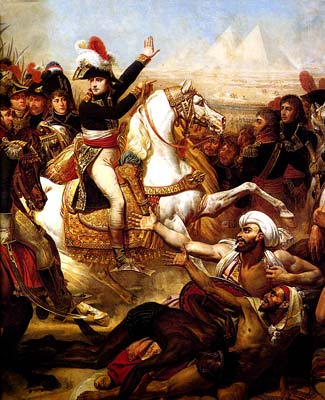
Napoleon invades Egypt.
One major impact Napoleon had on political systems of Europe was the meritocracy he set up. Instead of rewarding citizens with goods or money based on their social class, people were now rewarded based on their skill level. This made for a more fair system. While social class, and how much influence you had in government, used to play major roles in what you were rewarded, politics no longer has an influence on your salary, which is how it should be. Napoleon was able to make property to own more readily available to more citizens. This gave people more places to live and even start a business, and took out the politics of only certain people being able to own property in the European society. While invading Egypt, Napoleon made yet another feat. He was able to reorganize the Egyptian government with also creating the Institute of Egypt. This not only made one central government for Egypt, but also began the study of ancient Egypt, that we still carry on today.
Napoleon Bonaparte was not only a great ruler of an empire, but also a very good military leader. Marshal Michel Ney, a military leader working with Napoleon, called him "our august emperor." Napoleon was able to accomplish a lot of things in his life, and as Phineas Camp Headley puts it ever so simply, "Napoleon was great."
Picture Source:
Napoleon invades Egypt:
http://www.ancient-egypt.co.uk/people/pages/description_de_l'egypte.htm
Napoleon Bonaparte was not only a great ruler of an empire, but also a very good military leader. Marshal Michel Ney, a military leader working with Napoleon, called him "our august emperor." Napoleon was able to accomplish a lot of things in his life, and as Phineas Camp Headley puts it ever so simply, "Napoleon was great."
Picture Source:
Napoleon invades Egypt:
http://www.ancient-egypt.co.uk/people/pages/description_de_l'egypte.htm
Monday, October 6, 2014
The Luddites Sending Massages
The Luddites were skilled weavers, mechanics, and other artisans who were followers of the mythical figure 'Ned Ludd.' As a sign of protest towards their cause, the Luddites would attack machines and factories during the time of early industrialization. The Luddites were not opposed to technology, as it seems like they are. The Luddites attacked machinery to show that they were upset that machines were taking the place of human workers. There was an economic upheaval created because so many people were out of work, because the machines had taken their place. Unemployment was a major reason for destruction but also providing food became a daily struggle. The following is a made up primary source letter that shows the perspective and opinion of a soldier who was trying to contain and break up destruction to mills and factories caused by the Luddites.
 |
| Pictured above is 'Ned Ludd.' The Luddites were followers of him and believed his ideas. |
Dear Anna,
Hello again my Anna. I hope you and your family are staying safe. The Luddite's cause has grown since the last letter I sent to you. The Luddites are a jealous type who just want their simple jobs of creating goods by hand back. The Luddites are unable to see the beauty of these new technologies. Their destruction and terrorism of our mills and factories is horrifying to those closely related and is making the rest of the country scared for their lives. You know my mother once produced cotton goods from our home, but has been forced to stop due to the new factories. Though effected at the time right after this loss, she was able to understand the meaning of the new machines and loves the benefits they have had on our society.
Anna, I have not been able to understand why the Luddites are unable to see the greatness mass production will bring to the world. The Luddites have forced me to take extra shifts to protect innocent citizens who could be faced with the danger these maniacs are capable of at any minute. My job as a soldier is to protect my country, and having the Luddites around makes my job that much harder. I have been placed on evening duty to protect the factories from invasion, and I am doing my best to stay out of danger. Nothing can be anticipated with this inept, malicious crowd wanting revenge on the mill industry and new technologies. Wish me luck Anna and I hope all is well in America.
Anna, I have not been able to understand why the Luddites are unable to see the greatness mass production will bring to the world. The Luddites have forced me to take extra shifts to protect innocent citizens who could be faced with the danger these maniacs are capable of at any minute. My job as a soldier is to protect my country, and having the Luddites around makes my job that much harder. I have been placed on evening duty to protect the factories from invasion, and I am doing my best to stay out of danger. Nothing can be anticipated with this inept, malicious crowd wanting revenge on the mill industry and new technologies. Wish me luck Anna and I hope all is well in America.
Love to you and your family,
Edward
Subscribe to:
Comments (Atom)