Friday, October 31, 2014
Congress of Vienna Talks Power
When a king or president is having their power threatened, they will do everything they think is right and justifiable to get their power back. For example, in class, we took real decisions that Prince Charles von Metternich was faced with and had to decide what his actual actions were. We had to decide what Metternich would do about the redrawing of the map of Europe, establishing a new leader of Europe with the absence of Napoleon, and how to discourage new revolutions from occurring.
In preventing new revolutions, the Principle of Intervention was introduced. This principle was brought about because of the warfare Metternich had seen spread across countries that caused many deaths. It was the idea that if a country in Europe was experiencing revolutions, other European countries had the right to enter into the revolutionary country and break up the revolutions. The country intervening with the revolutionaries had the order to restore monarchs to their power. With this ideal in place, many future revolutions were stopped and monarchs kept their power. If a revolution did occur, it was considered treason and against the will of God, therefore making it highly punishable. Governmental forces were able to crush revolutionaries and protect the monarch's power.
I do not completely agree with the Principle of Intervention and think there is a better way to go about the situation of revolutionaries. The Principle of Intervention would only cause more death of the people of a country, not create lasting peace. A better way to go about this may have been for monarchs to show more kindness towards their people in order to stop ideas of revolutions. The leaders in Europe should have thought of giving the people of Europe more rights, like religious freedom and freedom of speech, so as to make their people happy and give them no reasons to revolt.

Thursday, October 16, 2014
Star-bursts and Capitalism
During our class experiment, we were each given 3 stars bursts by Ms. Bailey, but three people were given 10. Once explained, we were able to play each other in Rock Paper Scissors Shoot. If we won the game against the person we played, we took one of their star-burst from them. This was representational of an open market where everybody was able to compete for star-bursts, money. If you lost all of your star-bursts, you were considered out. There was stealing that went on among classmates to gain more star-bursts as well.
The first part of this experiment showed us capitalism at work. Once our alloted time was over, Ms. Bailey collected everybody's star-bursts and redistributed them to everybody so no person one had more than any other person. This showed us socialism where everybody is considered equal. Now with everybody being equal, the game started again. With Ms. Bailey having no control over any aspect of the game, this part of the experiment showed us communism.
I thought that playing the game was both fun and frustrating. I thought it was funny to see how different people thought and reacted during the game. It showed what people were adventurous and who just wanted to be content with what they had. I thought Jacquelyn's reaction to people trying to steal her candy was funny as she brought out a ruler and warned Julia and myself that it has a sharp edge. My frustration came from losing a star-burst to such a simple game like Rock Paper Scissor Shoot that is based on luck and cannot show skills or talents you have.
From our class discussion the next day, I heard a lot of options I can agree with. I truly agree with Catherine when she said that playing the game using Rock Paper Scissors Shoot was unfair because it showed a person's luck and not their skill. It also did not take into effect the position that person holds in society. I also agree with Austin when he said that the invisible hand, proposed by Smith, is only good to run small businesses but is not suitable for the entire economy. An example that shows this is the supermarket Atlantic and the invasion of bigger supermarkets like Market Basket and Stop and Shop. The invisible hand was working well without these big supermarkets because Atlantic was able to compete with other small markets and stores that sold similar things to them and they were in competition to keep prices low. With Market Basket and Stop and Shop now present, Atlantic was unable to keep up with the demand that was expected of them, based on what bigger supermarkets were doing. The invisible hand is not the best idea because though the economy will eventually balance out, it will take a very long time. And with this in mind, this is the reason we see the government having to step in and take charge in the economy so they are able to balance it themselves and control it.
Marx did not believe in the ideas of capitalism and was known as the father of socialism and communism. He believed that with the freedom to complete in capitalism, there will be classes that came out with lots of money and classes with little or no money. The poor classes would experience a struggle and complain about it. In addition workers will revolt against the system and there will be people who liked the free market and others who hated it, based on their success. The government will then be forced to collect all the assets of the people and bring economic equality to all of its people. The aim of this is a classless society where everybody is equal. This shows how socialism works. Once this classless society was established, there would be no more need for a government to control its people, leading to communism. This is the poor helping itself because everybody in the society is equal and there is no longer a 'poor' class anymore.
Smith on the other hand, had a different idea of how things should work. He believed in the invisible hand. This idea suggests that when the government leaves the market alone, it will balance itself out. For example, if a bread store has bread for a price of $2 but another store across the street sells bread for $1.50, this will cause the price of bread to be driven down. This is because the first store will want to be able to sell their bread, but twitch he store across the street selling it for less, they will have to lower their prices, as well, in order to compete. The constant lowering of prices in order to compete for customers, helped the poor because they were now able to buy goods they need at lowered prices.
The best option for running a government is neither capitalism nor socialism nor communism. All of these situations are extremes that are unattainable. A perfect society would contain a little bit of everything, but not too much on one place. The government doesn't always need to be in control of the economy, but also should not be in total control. For parts of society that can handle themselves, such as small businesses, do not need be controlled by the government because the consumers in towns or cities are demanding what they want our of these businesses, and the small businesses are able to give them what they want with high quality. In contrast, big companies need to be controlled by the government so they do not take over and kick all small businesses out or turn into a monopoly. A monopoly would not be good for anybody because one company would have control over everything and nobody else would have a say in the economy.
The best option for running a government is neither capitalism nor socialism nor communism. All of these situations are extremes that are unattainable. A perfect society would contain a little bit of everything, but not too much on one place. The government doesn't always need to be in control of the economy, but also should not be in total control. For parts of society that can handle themselves, such as small businesses, do not need be controlled by the government because the consumers in towns or cities are demanding what they want our of these businesses, and the small businesses are able to give them what they want with high quality. In contrast, big companies need to be controlled by the government so they do not take over and kick all small businesses out or turn into a monopoly. A monopoly would not be good for anybody because one company would have control over everything and nobody else would have a say in the economy.
The Bon Bonaperte
Napoleon Bonaparte ruled a successful government. Though, some may say the way he ruled way not that pretty. Madame de Staël, a member of nobility who was closely connected with King Louis XVI, argues that "[Napoleon's] system [encroached] daily upon France's liberty and England's independence," but Napoleon's accomplishments, still, are undeniable.
When discussing social issues Napoleon contributed to, he was able to abolish titles of serfdom and nobility across Europe. This gave everybody equal class and no one person was considered higher than another. In this way, Marjorie Johnson's idea that Napoleon was "a great reformer" can be proved correct. Napoleon also ended Chuch privileges, which would make Chuches exempt from taxes or other things of that sort. Napoleon was able to give more people access to an education. With this, people could get educations and were able to communicate with each other in more sophisticated ways. This was a benefit to Napoleon's ruling because it made more people in his empire literate and smarter.
Napoleon Bonaparte made giant advances in the economic system of Europe, as well. For starters, Napoleon was able to control prices of goods while stimulating and encouraging industry. This helped everybody in Napoleon's empire because everybody knew the price of a good would be consistent, but also industries would be growing and thriving. In addition, Napoleon balanced the budget and also established the Bank of France. This gave the French economy solid footings and one central place for finances. Napoleon removed trade barriers that once stood between countries. Through this demolition, people were able to trade more freely between countries without barriers restricting them.


Napoleon invades Egypt.
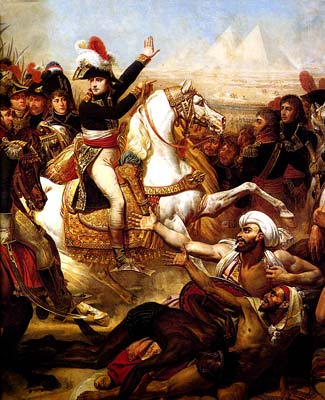
Napoleon invades Egypt.
One major impact Napoleon had on political systems of Europe was the meritocracy he set up. Instead of rewarding citizens with goods or money based on their social class, people were now rewarded based on their skill level. This made for a more fair system. While social class, and how much influence you had in government, used to play major roles in what you were rewarded, politics no longer has an influence on your salary, which is how it should be. Napoleon was able to make property to own more readily available to more citizens. This gave people more places to live and even start a business, and took out the politics of only certain people being able to own property in the European society. While invading Egypt, Napoleon made yet another feat. He was able to reorganize the Egyptian government with also creating the Institute of Egypt. This not only made one central government for Egypt, but also began the study of ancient Egypt, that we still carry on today.
Napoleon Bonaparte was not only a great ruler of an empire, but also a very good military leader. Marshal Michel Ney, a military leader working with Napoleon, called him "our august emperor." Napoleon was able to accomplish a lot of things in his life, and as Phineas Camp Headley puts it ever so simply, "Napoleon was great."
Picture Source:
Napoleon invades Egypt:
http://www.ancient-egypt.co.uk/people/pages/description_de_l'egypte.htm
Napoleon Bonaparte was not only a great ruler of an empire, but also a very good military leader. Marshal Michel Ney, a military leader working with Napoleon, called him "our august emperor." Napoleon was able to accomplish a lot of things in his life, and as Phineas Camp Headley puts it ever so simply, "Napoleon was great."
Picture Source:
Napoleon invades Egypt:
http://www.ancient-egypt.co.uk/people/pages/description_de_l'egypte.htm
Monday, October 6, 2014
The Luddites Sending Massages
The Luddites were skilled weavers, mechanics, and other artisans who were followers of the mythical figure 'Ned Ludd.' As a sign of protest towards their cause, the Luddites would attack machines and factories during the time of early industrialization. The Luddites were not opposed to technology, as it seems like they are. The Luddites attacked machinery to show that they were upset that machines were taking the place of human workers. There was an economic upheaval created because so many people were out of work, because the machines had taken their place. Unemployment was a major reason for destruction but also providing food became a daily struggle. The following is a made up primary source letter that shows the perspective and opinion of a soldier who was trying to contain and break up destruction to mills and factories caused by the Luddites.
 |
| Pictured above is 'Ned Ludd.' The Luddites were followers of him and believed his ideas. |
Dear Anna,
Hello again my Anna. I hope you and your family are staying safe. The Luddite's cause has grown since the last letter I sent to you. The Luddites are a jealous type who just want their simple jobs of creating goods by hand back. The Luddites are unable to see the beauty of these new technologies. Their destruction and terrorism of our mills and factories is horrifying to those closely related and is making the rest of the country scared for their lives. You know my mother once produced cotton goods from our home, but has been forced to stop due to the new factories. Though effected at the time right after this loss, she was able to understand the meaning of the new machines and loves the benefits they have had on our society.
Anna, I have not been able to understand why the Luddites are unable to see the greatness mass production will bring to the world. The Luddites have forced me to take extra shifts to protect innocent citizens who could be faced with the danger these maniacs are capable of at any minute. My job as a soldier is to protect my country, and having the Luddites around makes my job that much harder. I have been placed on evening duty to protect the factories from invasion, and I am doing my best to stay out of danger. Nothing can be anticipated with this inept, malicious crowd wanting revenge on the mill industry and new technologies. Wish me luck Anna and I hope all is well in America.
Anna, I have not been able to understand why the Luddites are unable to see the greatness mass production will bring to the world. The Luddites have forced me to take extra shifts to protect innocent citizens who could be faced with the danger these maniacs are capable of at any minute. My job as a soldier is to protect my country, and having the Luddites around makes my job that much harder. I have been placed on evening duty to protect the factories from invasion, and I am doing my best to stay out of danger. Nothing can be anticipated with this inept, malicious crowd wanting revenge on the mill industry and new technologies. Wish me luck Anna and I hope all is well in America.
Love to you and your family,
Edward
Thursday, October 2, 2014
Single Ladies Become More Independent
The Industrial Revolution brought about change in our world, and not just technological advances. The dynamic of the country was changing, especially the economy. With the introduction of machines and high-productivity factories, the importance of home-produced goods made by women from their own homes declined greatly. Instead, a commercial economy developed.
With the introduction of mills and factories, women had the choice to live more independently and step outside of the limitations imposed on the farm. When women worked in the mills in Lowell, for example, they were able to make money for themselves for most likely the first time in their lives. With the money they made, they were able to buy goods for themselves, such as shoes, or they could send it home to their parents to help pay for the house and other necessities. Women were also able to save for dowries or even and education for their future. Women viewed their work in the mills as a temporary stage of life and not a career. Maybe the biggest motivation to go and work in the mills came from the idea of gaining independence from their families and being able to live by themselves.

The Industrial Revolution opened many new doors to girls and women. It gave them a chance to live away from their families and to make money for their own benefit and sometimes their parents and family's benefit. They were able to learn responsibility by "living all alone."

Though women were given all of these opportunities, restrictions were also put on them. Women were forced to live in boarding houses provided by the mills. Mill owners controlled the lives of their workers and the hours they did things. Women worked from very early in the morning until late at night, and sometimes did not even get breaks for meals. Women also had problems in the government. They were unable to vote or own property. It was almost impossible for women to have a life outside of their families.
People in the 1800s saw women as unworthy of rights that were given to free men. Though these women were free, a right passed down from their fathers who were also free, they were not treated that way. They did not have all the abilities their fathers had, but should have been given. There was no sense of respect towards the women during this time even though they worked hard to make a living for themselves, and sometimes their families as well. Women deserved as much respect as the men who did equal work received from society. When respect was not given, these tough women were able to fight against the inequalities of the world and have gotten us to where we are now
.
.
Subscribe to:
Comments (Atom)